Tuesday, March 18, 2008

SARAMAGO's Blindness: Discussion Questions


A
pocalyptic stories are always in demand. We are energetic fantasts of our own doom, endlessly fascinated by seeing it writ large (although we in the west require endings with salvation & hope). Note the enduring popularity of such works in literature & pulp alike, from McCarthy’s The Road to Will Smith’s revision of I Am Legend.

In fact, Atwood will help us end civilization as we know it again in May.

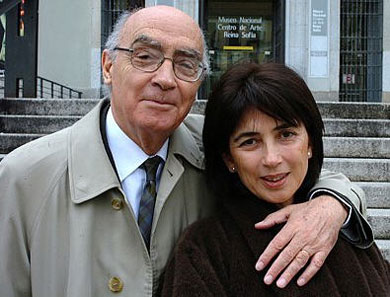
The son of illiterate pig farmers, Portuguese Jose Saramago began writing novels in earnest in his late 50s & won the Nobel Prize for literature in 1998. He’s a notorious crank, a communist & an old world atheist. Like Rushdie (& the old man with the eye patch?) he married a beautiful woman 30 years his junior. His drunkenly bastardized surname means ‘wild radish’. His daughter (a biologist) is named Violante.

Spoiler warning.
The following reveals plot & character details.

Here's a good NYT profile by Fernanda Eberstadt. It has a section on Saramago's narrator (page 6), who is the reporting spectator in most of his books.

A movie of Blindness is coming out soon. How could they not? The scene in which they’re fleeing the burning asylum alone is sparking with cinematic promise. I’m encouraged to see it stars Julianne Moore & is directed by Fernando Meirelles (The Constant Gardener).

This is still one of my favorite books & it was a pleasure to re-read it for the group this month. Enjoy!

~A. Campisi


______________________________

DISCUSSION QUESTIONS & SUGGESTIONS

All page numbers are from the paperback Harcourt Brace edition.


The WRITING

FORM. One of the great feats of this books is its stripped down form. It’s unpunctuated with chapter titles, white space or italics, few paragraph breaks or speaker tags (= “he said”), & for a book that is so heavily dialogue-based: no quotation or question marks, exclamation points, or line breaks for speaker shifts, separating adjacent speakers only by commas & capital letters. He does not even use character names. Amazing to me: he achieves this without stumble or confusion.

He makes similar choices in other works as well, notably the excellent & often-banned Gospel According to Jesus Christ, but there is no book better suited to this style than Blindness.

First, how did the formal choices affect your reading experience? Was there a learning curve? Any other observations of formal choices?

Second, how does the style specifically fit & add to the book’s themes?

TENSE. One of the techniques that impresses me the most is Saramago’s free flow of tense. Specifically, he’ll change without warning from past to present & then back again, often in the middle of a sentence, & he does it seamlessly. I’d be curious to know how many readers noticed this happening & what you thought of it when you did catch it. He does it on the first page, for example. Also p 202, 210, 274 (a nice close-up of the lamp flames), etc.

More elegantly he does it on p. 155, just for a moment, as a tool not only to shift & narrow our focus—functioning as a camera might do a close-up in a movie—but also for switching the point of view. This is masterful work.

Here’s that example (p 155):

The doctor’s wife has wandered out by the gate at night, a soldier outside it with a torch. We been for a long time in the doctor’s wife’s POV, she’s sitting, contemplating the scissors, then the next sentence begins:
The soldier approached the gate, although he is standing against the light, it is clear that he is looking in this direction, he must have noticed the motionless shadow, although, for the moment there is not enough light to see that it is only a woman seated on the ground...the soldier points the beam of a torch at her, now there can be no doubt, it is a woman who is about to get up...in a flash he asks himself whether he should raise the alarm...as a precaution he points his weapon in her direction, but this means putting the torch aside and, with that movement, the luminous beam shone directly into his eyes...” from then on it's in past tense.

NARRATION. Who is the narrator do you think?
I ask because while totally reliable & omniscient, it often swoops in with an “I” or a “we”, & freely uses rhetorical markers (like: that is to say; in a word; so to speak; as we imagine it), which function as indicators of candor & authenticity, but also insert some distance in the reporting, making sure we see that it’s a mediated story, either written or told.

Sometimes it speaks inclusively, as if the narrator were there, too (even referring to “our blindness” (218)). Sometimes it appears to be looking on aloof, proposing thought experiments: “Let us put ourselves in the place of the soldiers....Let us remember the precedents...” (111) Is it the writer they meet later? Is it speaking as Humanity? Is it the author? What did you make of it?

__________________________

the STORY

STRANGERS. “Who spoke, It was me, Who is Me, Me” (99). Here’s the book of all books to talk about our theme. In a nameless city & country, they are strangers from beginning to end. Even “Names have no importance here.” (59) Why do they never give names & insist that the blind do not need them? When the women return from the orgy, they "are different women now". How instead do we know one another--or ourselves?

WHITE. Why do they see white, “a milky sea”, “like a light going on”, instead of darkness or nothing?

BLINDNESS. What’s being investigated here? This question comes up again & again throughout the book. It's answered differently by different characters. Why are they blind & what does it mean to be blind. What is “blindness”?

What do you make of this: “Perhaps only in a world of the blind will things be what they truly are, said the doctor.” (126)

Or this, “The blind are always at war, always have been at war” (193)?

DOCTOR’s WIFE. Surely one of the great heroines of contemporary literature. What did you think of her character? Why does she retain her sight? How do you interpret the last page of the book?

What did you think of her saying: “I shall become more and more blind because I shall have no one to see me.” (317)

The STUFF WE’RE MADE OF, “This is the stuff we’re made of, half indifference, half malice.” In the context of the book, do you agree?

COMMUNISM. “From each according to his abilities, to each according to his needs.” (141) What do you make of Saramago using this Marx quote here? What other political statements does this book make? Organization. Leadership. Duty. Morality. Tyranny. Law. Equality. The Government. The Military. The People.

TYRANNY. Saramago grew up under the fascist Salazar dictatorship. Whether or not there are specific allusions to that history, however, there’s a stunning political allegory to be had in the mass dissent & then uprising against the armed thugs holding their food (163-164). Why does it fail when the numbers are on their side? What’s the larger story being told here?

WOMEN. So much to discuss here. The doctor’s wife’s leadership. Sexuality. The sexism of individuals. “No great shakes” Focus on the shattering order to present the women in exchange for food (beginning on 166).

Talk about the debate & moral discussion, how exactly the women volunteer & then prepare themselves in their own ward. Talk about their compliance, especially in relationship to their men & after their dissent when it was only money the thugs wanted. Why do they comply?

Later, what changes that allows for a successful group & individual (terrorist?) rebellion?

AFFAIR. Talk about the doctor’s affair with the girl with dark glasses, the wife’s & girl’s reactions.

DOG OF TEARS. Talk about the dog of tears. What might he represent?

CHURCH of the BLIND GODs. There’s a very powerful image at the end, when the doctor & his wife are taking shelter inside the church where she alone can see that all the statues, paintings & even the crucifix have had their eyes either bandaged or whited out. When others learn this is true, they panic. After which: the doctor & his wife take their food.

First, what might this mean in general that this has been done?

Second, go through the specific list of images (316-317) & see if you can make any closer analyses. Beyond the simplest image x = character y connections, let’s consider for starters how the character of the doctor’s wife deepens with the image that: “there was only one woman who did not have her eyes covered, because she carried her gouged-out eyes on a silver tray.” (that is a painting of Saint Lucia, by the way)

FREE WILL. Does Saramago's purported atheism make sense to you given what you’ve read? Does it affect how you interpret parts of the book?
Maybe he’s an atheist, but there’s a lot of spirituality here. There are persuasive arguments out there, too, that this book can be read through a Christian lens, even a Catholic message of using free will in a dark age. What do you think?

ALLUSION. Who recognizes this allusion? p. 158: the doctor’s wife is spying on the sleeping thugs. “The blind man was sleeping, his head resting against the door jamb, his stick had slipped silently to the floor, there was a defenceless blind man and with no columns to bring crashing down around him.” What do you think it means in this context?

PROVERB. “As the old proverb never tires of teaching us, while trying to cross himself the blind man only succeeded in breaking his own nose.” (17) Was anyone else reminded of Aadam Aziz, of Midnight’s Children, breaking his nose while bowing to God?


_________________________________

A NOTE for approaching Gulliver's Travels

This classic isn't really long, but the language is old & so you'll want to give yourself some time. Remember what I warned you about with Rushdie? And did you listen? Start reading now.

Also, many versions of Gulliver's Travels come with introductory essays & contextual analysis. I don't recommend any one in particular, but the book & discussion may be more fun if you've read a little about the context. (Only because it's the one on my shelf) I'm going to use the Penguin Classics paperback & will refer to page numbers there. Have fun with it!

Sunday, February 17, 2008

RUSHDIE's Midnight's Children: Discussion Questions


Alas for poor pickle-nosed Saleem, disintegrating in a Bombay pickle factory, foretelling that—like Scheherazade—his life will end when (if not before!) he finishes his tale of 1001 ‘Midnight’s Children’.

If you ever have a chance to hear Salman Rushdie speak in person, I recommend it. He has more of the world in his head than most. He’s bitterly funny and furious, a man perennially condemned to death for his writing. He speaks with all the wit and eloquence of Old World erudition, yet remains as willing to cite the merits of Blade Runner as Persia’s 12th c. Rubaiyyat.

Perhaps that’s the least we should expect from a best-selling author dubbed a Knight & an Apostate both.

I met Rushie once, if fleetingly. We were introduced one evening in Ithaca, NY (where you can meet a surprising number of accomplished artists without a huge crowd at your elbow). Our author-host encouraged him by generously naming me a ‘very promising young writer’, at which point his eyes glazed over as if to plead: Oh, God, not another one.


Fair enough. The “promising young” are a dubious lot.


He did share a magnificent anecdote, however, about the extremes of defending freedom of speech, which is roughly represented here, under International Guerillas.

The title, Midnight’s Children, is taken from a speech by then-prime minister Jawaharlal Nehru, delivered at midnight of 14/15 August 1947 to mark India’s independence from England. In 1993 the book, Rushdie's second, was awarded the "Booker of Bookers," a honor accorded to the best novel published in the competition's first twenty-five years.

This story comes at you through a fire hose—and not always one that feels under control. From its stuttering start to its full-bore finish Midnight’s Children is a tour-de-force, thematically & literally a giant work. There’s a different lens for every fan.

Rushdie is not an author you ask for lean precision; he’s a writer one turns to for the Truth.

Suffice to say it’s far more than any set of twenty questions can cover, so let’s just jump in for fun.

_____________________________________


Discussion Questions & Suggestions


"There are so many stories to tell...so dense a commingling of the improbable and the mundane! I have been a swallower of lives; and to know me, just the one of me, you'll have to swallow the lot as well."


Personal Passages

Last month, I suggested reading Midnight’s Children with an eye for short passages—a single image, exchange or event—on which to do a close reading & then bring as a personal contribution to your meeting.

If you chose to do that, you might begin by sharing those.


What were some of your favorite images?


The Storyteller’s Truth

When & with what image would YOU begin your own life story? Why would you start there?


The ‘beginning’. Saleem begins the story of his life with his birth: the stroke of midnight, August 15, 1947, at the exact moment India gained its independence from British rule. Then he immediately backs up and begins again with his grandfather, emphasizing the importance of genetic heritage, legacies, identity. “I must commence the business of remaking my life from the point at which it really began.” Why does he begin his life’s story there?


The Frame Story, ie: the narrator’s present-day story that frames the rest, a la Arabian Nights, where Scheherazade telling stories to save her life is the Frame for her 1001 tales.

(Most wonderfully, this device (a frame story) is also called: Rahmenerzahlung. Though take it from me, who's tipsily apt to pop off with words like Operculum & Rahmenerzahlung to pretty things at parties: it's really better not to use this word in public).

Get yourselves on the same page with the frame story, in which the dying 31-year-old contrives to tell us his life story, literally & allegorically, before crumbling to dust.
What is this about? How does returning now & then to the Frame Story function as a valve for the histories this “swallower of lives” tells us?

MC. Can you agree on a basic version of the story it contains?

1001. Saleem tells us Midnight’s Children parallel the history of the post-colonial nation. Do they? Is this allegory doing more than giving us a comprehensible scale of suffering?

Methwold’s Estate. Of what significance is Saleem’s growing up on the Methwold estate & the manner in which it, and everything inside it, is bequeathed to them?

The Center of Everything. Saleem is a highly self-conscious autobiographer, often self-centered, needy, even narcissistic. He’s convinced (rightly?) that he is at the center of Indian nationhood, “handcuffed to history”, intent that his life means something. What do you make of the narrator’s attitude?

Padma. How does Padma’s character, the narrator’s irreverent, illiterate care-taker & lover, guardian of ayah Mary’s chutney factory, balance Saleem’s narration?

An Unreliable Narrator. Saleem gets some facts wrong & even tells some outright lies. He withholds critical information. When he gives the wrong date for Mahatma Ghandi’s death, for example, he admits: "But I cannot say, now, what the actual sequence of events might have been; in my India, Gandhi will continue to die at the wrong time."

So it’s the Truth vs. the Facts again: one of my favorite themes. Or as Rushdie puts it: the 'Remembered truth' vs. the ‘Literal truth’.

How did you take to Saleem’s unreliable narration? Why do you think Rushdie made him that way?

Are his ‘Remembered Truths’ more or less truthful or authentic than the Pakistani government’s Truths? What are the differences there?

Rushdie has a very short essay here called: 'Errata': or, Unreliable Narration in Midnight's Children, which is worth glancing at if you’re going to talk about Saleem as an unreliable narrator.

Not His Whole Story. He is ‘remaking’ his life, after all. For all his emphasis on biology & destiny, for all that Saleem appears to have ‘inherited’, this family history is not his biological own. Why does Saleem wait so long to tell us he was switched at birth? Or to say who his real parents were?

How does his biological parentage change his relationship to his family history? To India / Pakistan’s story? How does it fit into the history his life is said to parallel?

The Switcheroo. What is the effect & significance of switching these particular characters, Shiva & Saleem?


"Occult Tyrannies"

Several of our season’s books have made it clear that we are constantly surrounded by portent signs and omens merely waiting for our awareness & interpretation. Consider sharing (& interpreting) a distinctly Rushdian sign or omen from your own life.


Talk about the role of Fate & Foreknowledge in the novel.

We know from the first pages that Destiny looms large here.

For example: Frozen ‘rubies’ of blood & ‘diamonds’ of tears fall from Aadam Aziz’s nose. A page later, after his father has suffered a stroke, his mother starts a gem business, selling rubies & diamonds. Later, Aziz sees his future wife’s face for the first time on the same day World War I ends, in 1918. There’s a self-conscious concern for fateful signs here, even if that only emerges in the telling.

How do these signs work as forces in the story? In characters’ lives?

Similarly: Pre-cognizance. That he would lose a finger. That the war would save Shiva. That Musa would bring destruction. On & on. Some of it is Saleem's exaggeration, an authorial license, but some of it is authentic. What is the reality, role & effect of such prescience?

( it is, of course, somewhat easier to seem 'omniscient' when you're narrating history.)

Handcuffed to History. Saleem claims he’s responsible for a great many things, from his father’s alcoholism to various affairs of state. Why does he believe that so much of what goes wrong is his fault? What does he mean by claiming fault? Is he responsible?

• One thing about Rushdie, he likes to interpret his own symbols for us sometimes, perhaps before anyone else can get them wrong. Were there any explicit authorial interpretations that you particularly appreciated?

Why does Rushdie destroy Saleem's entire family with disease, war, and natural disaster?


Fragmentation

“Please believe that I am falling apart. I am not speaking metaphorically”

What would be the most allegorically appropriate way for you to depart the world?


Aziz falls in love with his wife by seeing her piece by piece through a sheet.

Saleem is inexorably falling apart, literally being ground to hundreds of millions of pieces.

Other examples of fragmentation? What is this theme about?

What do you make of Saleem’s fate—crumbling to dust, the hundreds of millions of pieces? What does that represent?


Biology & Destiny: the Super-Natural

Assuming you were born at the stroke of midnight on the Independence of your home (or host) country, what supernatural power have you been granted? If you can do so safely, please demonstrate it now for the group.


War-knees. A nose the size of the Indian subcontinent & birthmarks on either side. Talk about the Supernatural powers accorded to various MC, depending on how close they were born to midnight. What is the meaning and nature of each, to the extent that you can say?

Shifting Powers. What do you make of it when Saleem loses his telepathy with the surgery, then gains a sense of smell that detects emotions?

Amnesia. Why does he lose (& then regain) his memory?

Why is (Muslim) Saleem known as "buddha" during his time as an amnesiac soldier in the Indian-Pakistani conflict?

Inheritance. Saleem has ‘inherited’ the huge nose & blue eyes of his grandfather, yet later reveals he was switched at birth. What does this say about biology & destiny? How does this personal twist in telling a life story parallel the turmoil of post-colonial India itself and the struggles of nationhood?


Proboscissimus! The Nasal Motif

Please point out for the group one of your own specific physical traits (for example, your birthmark the shape of the highly gerrymandered 64th district of St. Paul) & explain to the group it’s allegorical significance.


The Noses! (& their vegetable counterparts: cucumbers (& their phallic associates)) play surprisingly significant roles in this book. List out some of the examples. What’s going on with this choice?


Strangers in Their Own Land:


• Consider our theme. At once heralded as the very embodiment of sovereignty & nationhood, Midnight’s Children are nevertheless hunted down for extermination. Why?

What does this hunt reject? What does this choice mean?

How does this relate to the Indo-Pakistani war, justified on religious grounds, cleansing a nation, purified for the good of the country?

Why sterilize & release rather than, say, murder them all?

[Here it may be important to note two things:

1. “The Widow”, India’s prime minister, Indira Gandhi (no relation to Mahatma Gandhi), carried out the forced sterilization of Midnight’s Children. In real life, Indira Gandhi did implement a voluntary sterilization policy, followed by her son Sanjay’s highly unpopular campaign of forced sterilization of the poor in the late 1970s.

2. Related sections of the original version of Midnight’s Children resulted in a libel suit with Gandhi, forcing Rushdie to make revisions.]


Religion, Morality, Authority:

The hole. When Aadam Aziz bows in prayer, he cracks his great nose on the ground, & in doing so loses his faith in God. “A hole” opens up inside him. Discuss the significance & consequence of this. Is this related to the hole in “the perforated sheet”?

Discuss the shifting Bases of Authority. Throughout the book we find people finding & losing faith, shifting bases for religious conviction, exploring the use & abuse of religion by the state (ie: when Ahmed’s assests are frozen, presumably because he is a Muslim) & the role it plays in daily fear (our characters terrified that Mahatma Gandhi’s murderer might turn out to be a Muslim, relieved when he proves to have been Hindu).

Snakes & Ladders: is presented early as a childish, hopeful binary of Good & Evil. Later Saleem is saved by snake poison, giving him “an early awareness of the ambiguity of snakes.” How does the book deal with morality, good & evil? IS there any Good or Evil?

Scriptural Authority. What is Saleem’s relationship to Islam?

Muhammad. "(on whose name be peace, let me add; I don't want to offend anyone)" Do you think he (Saleem / Rushdie) does? Where & why?

Taking on a great mantle indeed, Saleem claims to have heard "a headful of gabbling tongues" after which he "struggled, alone, to understand what had happened," and later "saw the shawl of genius fluttering down, like an embroidered butterfly, the mantle of greatness settling upon [his] shoulders" What’s happening here?


Characters:

Parvarti and Padma?

FYI: Salman Rushdie’s birth name is “Ahmed Salman Rushdie”

(Sir Ahmed to us.)

Shiva & Saleem. Talk about this pairing, their switch, their powers, their relationship, their rivalry. Think about them not only as personalities, but economically, temperamentally, religiously, in terms of powers, motives & relationship to government / Partition.

This book has a very full cast of powerful female characters. Do you find any trends to discuss along those lines per se?

Are the women Saleem loves & woos critical to his story? Compare with Shiva's 'loves'.

• “The Widow” (Indira Gandhi) vs. the Dung-Lotus Goddess (Padma). How do these two women act as different motivating forces in Saleem’s present life (frame story).

Parvati-the-witch. His friend & wife, who later has an affair & child with Shiva. (In the Hindu religion, Parvati is the consort of Shiva, god of Destruction.) Why do you think Parvati is attracted to Saleem?

Whatsitsname! Grandmother Naseem Aziz, the Reverend Mother.

Aadam Aziz.

Mian Abdullah, instigator of the "optimism epidemic". IS Aziz's optimism a plague?

Tai, the ancient boatman.

The Brass Monkey, Jamila Singer, Saleem’s sister, the Voice of Pakistan

Fatal Biographies

A narrator aware that he will die when his story is complete may be tempted to go on longer than he should. Padma certainly agrees that he’s said more than enough. Do you? To the extent that you think the book is too long, what would you have cut & by how much?


Thursday, January 3, 2008

TAN's The Arrival: Discussion Questions


With The Arrival we come to the list’s most literal interpretation of The Stranger, not only in the hero's story of immigration to a strange new land, but with the graphic form itself: devoid of known languages, inviting us as readers along on the experience.

I heard Shaun Tan speak this past June at the enormous & excellent Sydney Writer’s Festival.

He came across as funny, candid & totally unpolished, a very likable, humble fellow, who talked about the four-year process of producing the 120-page, unnumbered The Arrival. Shy of over-burdening his family & friends, he used himself as the model for the principal character.

(There was a funny moment during his talk when someone in the audience asked him who he’d used, while Shaun Tan—standing right there, not far away—looks just about exactly like his character).

To find the most fluid movements & natural expressions, Tan assembled some of his panels from stills taken from video. He’d go out in his backyard, say, wearing a hat & long coat, set the camera rolling & then pick up a suitcase, walk a few steps, put it down, look up. He’d draft his friends & family to perform similar sequences, over & over again. His neighbors, who held to varying degrees of understanding what he was doing, would sometimes watch him in his yard.

His Chinese father immigrated from Malaysia to Australia in 1960. Tan grew up in Perth, where he was in different ways both a born-&-bred native & a stranger there himself. In part the book is inspired by his father’s stories, but The Arrival is far more universal.

Some images are adapted from people he’s interviewed. Some are taken directly—& recognizably—from sepia photos of Ellis Island. Others are based on things like a Tom Roberts' painting of a migrant ship bound for Australia, ‘Going South'. One of the project’s many origins was in the double-page illustration near the start—titled “The Old Country”—of dragon tails looping through a city, the family walking below. He didn’t know what it was about, but he wanted to find its story.

Tan’s excerpted essay HERE--found at the bottom of the page under “Comments on The Arrival”--is worth reading & pertains to our theme.

Shaun Tan has won the Australia’s prestigious New South Wales Premier’s Literary Award for 2007 (a true feat for a wordless book) & the World Fantasy Award for Best Artist. Since its US release in October 2007, it’s enjoyed such popularity that it was hard to find on shelves over the holidays.

Have fun discussing this one! I’ve included a short note about approaching Midnight’s Children at the end.

--A. Campisi

______________________________________

Discussion Questions & Suggestions

Favorites. Which is your favorite illustration or detail & why?

Strangers. What does it mean to be a Stranger here? Discuss our hero’s challenges toward finding himself at home in a strange land.

Alienation to Home. That's a basic arc here. What are the crucial events & elements that eventually allow him to transition from total alienation to finding himself more at home?

Cross-overs. For all his adaptation & assimilation, what (if any) images follow him from his Old Country to the New?

Readerly Empathy. Discuss the specific ways the form puts the reader in the hero’s shoes, as it were, making us better empathize with the protagonist / immigrant’s experience. Which did you feel were most affective?

Universality. A single immigrant’s story can’t be entirely universal, though the book makes a good faith attempt. What are some of the assumptions & choices it makes with respect to the immigrants themselves, the Old Countries, the New Country, the decisions to leave, and being a Stranger?

Transitions. One of the geniuses of this book is Tan’s ability to transition (wordlessly!) into & out of other people’s stories, fluidly changing narrators / point of view & even tense. The blond grocer tells our hero his story, for example, fleeing The Giants with big boots, vacuuming people up. The old man at the assembly line also tells his war story. Talk about that technique & those side stories.

The Fantastic. Elements of the aliens lands are merely different shapes (hats, stamps, snowflakes). Others are alien but guessable (food, animals, the postal system). Still other fantastical & allegorical (dragons, giants). Tan tries to walk a fine line between giving us something at once familiar & simultaneously alien. He’s snowed the protagonist (& us!) with elements we don’t recognize & yet must navigate. Talk about the use of surreal or fantastic imagery.

Other Choices. What other authorial choices did you find particularly interesting? Were there moves that didn’t work for you?

What is it? What do you think of this form: a wordless graphic novel? Is this book for adults? Kids? Is it literature? Do you think it deserved to win a general literary award in a category including all traditional books of adult literary fiction?

___________________________________________


A Note for Approaching Rushdie’s Midnight’s Children

This book won the Booker of Bookers, judged to be the best Booker Prize winner in the award’s first 25 years.

1. Start reading now.

This is a fantastic book, in all senses of the term. Rushdie writes some incandescent prose, imagery dense, intensely erudite, lyrical & passionate. It's not without flab, but what's good is well worth the extra pages. Suffice to say, this is not a book you can happily rush through in the last week without missing some crucial points & real gems.

2. With this book in particular you might find it fruitful to keep an eye out for short passages as you’re reading—say, between a sentence to 3 pages or so, settling on a single image, exchange or event—then do a very close reading of your selection & bring it with you as a personal contribution to the meeting.

CHABON's The Final Solution: Discussion Questions


He sat up, his head cocked at an angle that among parrots would have signified mild sexual arousal but that among apes denoted vigilance.”

(Bruno the parrot, in Michael Chabon’s The Final Solution)

In 1893, Sir Arthur Conan Doyle wrote a story called “The Final Problem,” in which the author plunges Sherlock Holmes over a cliff to his death.

Strangely (if not surprisingly), this didn’t take.

Doyle was weary of Holmes as a fixture in his life & as the definition of his career. However, as Star Trek fans may understand better than most, Doyle was totally unsuccessful in killing off his fictional character, who by then had taken on a life & fame quite independent of his maker. Outraged fans rallied for Holmes' resurrection & Doyle spent much of the next two decades churning out Sherlock Holmes stories. As a writer, I find this failure intriguing. And very alarming.

So it’s one final game afoot for The Old Man, as Chabon calls him, disinterring the ancient sleuth from obscurity & dereliction as a Sussex beekeeper. It came out in 2004, along with a shelf-load of other Holmes books, when the great detective turned 150.

But this is Michael Chabon [also HERE], so it’s not purely an homage to Holmes / Doyle. In The Amazing Adventures of Kavalier & Clay, for which he won the Pulitzer Prize, he also addresses the sorrow & horrors of Hitler’s Final Solution. Holmesian mystery or not, Chabon's The Final Solution is at least a timely study of social red herrings—specifically issues of security (eg: defense codes) & profit (eg: bank account numbers)—that distract from basic human tragedies.

At heart this is a book that asks: What is worth remembering?

So it's not just an homage. Neither, as some complain, is this truly (or purely) a work of genre fiction. In this respect Chabon is no snob: he's a writer who uses anything that works. His writing here flirts with a Victorian voice. Sometimes his phrases can seem shaken in a Boggle box & laid out as they fall, a sentence gambling on for a paragraph. But that’s quintessentially Chabon: super-energetic images; quirky characters; red herrings; a romping plot; erudition; tongue-twisting vocabulary; great pathos; The Human Condition. A willingness to pass the point of view to a parrot.

Here are some suggestions for discussion. As you’re talking about “The Arrival” as well, I’ve given you fewer than usual. I’ll append a note on approaching Rushdie’s book in the next post. Enjoy!

--A. Campisi

___________________________________

Discussion Questions & Suggestions


• During your meeting, just for fun, consider dropping at least 2 of the following Chabonian words in casual conversation.

Extra points for accuracy, topicality & straight faces.

.Ignis fatuus (pl. ignis fatui) .......Tatterdemalion

.Echolalia.......Bibulousness

.Dryasdusts.......Mundungus

.Aspergillum.......Gephryrophobia

_______________________________

If you didn’t know in advance, how long did it take you to recognize who the old man was? What were your clues?

For example: "Then he reached into the old conjuror's pocket ... and took out his glass. It was brass and tortoise shell, and bore around its bezel an affectionate inscription from the sole great friend of his life" (29)

What did you think about never naming Holmes?

"Years and years ago his name -- itself redolent now of the fustian and rectitude of that vanished era -- had adorned the newspapers and police gazettes ... " (43).

Separately, what did you think about calling him The Old Man, the only unnamed principal character? What effect did it have on your reading?

The Title. Talk about the various meanings & references contained in the title.

The Mysteries. So the old man solves his mystery with signature alacrity & style: He finds Bruno & reunites him with the boy. But that’s not the only game in town. Why is he so intrigued as to rise again to this particular mystery & not to the one that everyone else is trying to solve?

The Train Song. The sound of the train song, arising in the middle of the night, would jar the man from his slumber, send him scrabbling for his pencil & pad.” (117, Harper Perennial Edition) (This is my favorite page in the book.)

What is it that’s worth so much to remember? Answer the book’s other mystery: What is the parrot actually singing?

Revealing Errors. What do people think Bruno is singing with his German strings of numbers? What’s the basis for their various theories? Why don’t any of them guess the real answer? What’s the social commentary contained in those specific errors?

The Ending. What did you think of the ending, which does not spell out for you in so many words the answer to the mystery?

What do you make of it when the old man says at the end, "I doubt very much ... if we shall ever learn what significance, if any, those numbers may hold" (129).

Illustrations. What meaning or clues, if any, did you find in the illustrations?

Talk about the Panickers. Their name. Their racial mix. Their family dynamics. Their marriage. As foils. In context of the greater social themes of the book’s Zeitgeist.

Mr. Panicker "... his shame was compounded by the intimate knowledge that Richard Shane's brutal murder in the road behind the vicarage had echoed, in outline and particulars, the secret trend of his own darkest imaginings" (94). What are Mr. Panicker's 'darkest imaginings'? Why is he so tortured?

The Stranger. Talk about the old man in terms of our theme. How is he a stranger, how is he estranged?

The Stranger. More importantly, talk about the boy in terms of our theme. How is he a stranger, how is he estranged?

Selective Mutism. Why doesn’t the boy talk? Clearly his youth & his not speaking are at least a device to enable & preserve the mystery. What else does it add to the story?

The Writing. How does Chabon’s distinctive style strike you? How would you describe it? Examples of what you liked / didn’t like & why?

Bruno. What did you think of the chapter that slid into the parrot’s point of view? Why did or didn’t it work for you? What did it accomplish, do you think, that it could not have accomplished as well with a human perspective?

Friday, November 2, 2007

JOHNSON's House Mother Normal: Discussion Questions


Here we dive into the season’s most committed and formal exploration of identity. House Mother Normal: a Geriatric Comedy skins this onion all the way down. Our nine strangers live in an English geriatric facility for the poor and indigent at varying levels of senility and health. How much can you lose and still be yourself? How is one’s identity parceled and mediated? This book is filled with crass sexuality, surprising instants of pathos, vulgarities that run from shocking to farce, and totally raw pain.

***

If you haven't read the novel yet, be advised that the following contains some decodings & spoilers.
***

On the surface, we’re watching them “dining, first, and later singing, working, playing, traveling, competing, discussing, and finally being entertained.” (Also boot-legging, mop-jousting and bestiality). All the while, whole lives glide unnoticed above and beneath that surface.

As Mrs. Bowen says:

I may not be very................but I am


[Right up top here, let’s note that the December / January books are short, easy reads, both whimsical & fun.]


A 3-Dimensional Form

It goes like this: Each of the 9 characters has 21 first-person pages spanning the same events and hours of an evening. Thoughts are printed in Roman script, spoken dialogue in italics. Gaps and blanks represent different forms of consciousness, too (such as a memory lapse; a pensive reminiscence; shock; sleep; oblivion; etc). They almost all begin mid-sentence.

I call the form 3-dimensional because each page matches in time—line for line, second for second—with the corresponding pages for every character. So if you stacked and held up to the light every character’s page 13, for example, you’d see Ivy, Ron & Sioned having a simple and sensible conversation with one another, and later a separate spat between Ivy & Gloria. The House Mother addresses or dialogues directly with all 8 characters on that page alone. One character's 2-D page of prose is not enough to complete a movement. Stack the pages together & the whole room suddenly appears.


A Note from the Author

B.S. Johnson himself described HMN as a study of what is Normal vs. Abnormal. (This is interesting, but don't let it limit your discussion.)

“What I wanted to do was to take an evening in an old people’s home, and see a single set of events through the eyes of not less than eight old people. Due to the various deformities and deficiencies of the inmates, these events would seem to be progressively "abnormal" to the reader. At the end, there would be the viewpoint of the House Mother, an apparently "normal" person, and the events themselves would then be seen to be so bizarre that everything that had come before would seem "normal" by comparison. The idea was to say something about the things we call "normal" and "abnormal" and the technical difficulty was to make the same thing interesting nine times over since that was the number of times the events would have to be described. … Each of the old people was allotted a space of twenty-one pages, and each line on each page represented the same moment in each of the other accounts; this meant an unjustified right-hand margin and led more than one reviewer to imagine the book was in verse. House Mother’s account has an extra page in which she is shown to be

the puppet or concoction of a writer (you
always knew there was a writer behind it all?
Ah, there’s no fooling you readers !)

Nor should there be.”

Click here to read his whole essay on novels, truth in fiction, form, and his body of work.


Have fun with this one!

--A. Campisi

_______________________________________________


Discussion Questions & Subjects

Just to start yourselves out on the same page, as it were, you might begin your discussion by laying out some basic discoveries of Who, What & Where:

WHO: Characters. We know their names & statistics, and that having “no effective relatives, [they] are orphans in reverse”. But most of them reveal a great deal more. A Welsh house servant, a black prostitute, a war veteran and concert pianist cum street musician…Briefly and simply, just to set the stage, lay out the cast of characters as they revealed themselves.

WHAT: Sequence of Events. In chronological order, briefly & simply, what’s this Social Evening’s actual set of events?

WHERE: The House. What do you know about the House? What's the hierarchy of control? What are the patients’ general attitudes about being here?

‘Work’. What exactly are Sarah & Charlie doing with the bottles? How might their work—the dilution, the removal of labels, for example—function metaphorically?

•What are the others doing with the glue & red crepe paper?

Play’. When they play Pass the Parcel, everyone has a different reaction to what’s inside it, & not all of them are negative. How did you react? Is the parcel itself a metaphor?

Disgust. Do you take HM’s argument at face value, that “I disgust them in order that they may not be disgusted with themselves….” (HM 15; p 197)? What do you think of her argument?

Sex. There’s a lot of sexuality in this book. Histories are dominated by it. Passions endure. As do memories of abuse and longing and joy. Bawdy songs! Ron & Gloria stake breakfast milk against “a quiet feel in the toilet before bed” on the outcome of the tourney! And then there’s the HM & her Ralphie… Discuss sex.

Shit. Ron Lamson suffers badly from an inoperable rectal carcinoma. How do you read the coincidence of this with:

1) His being the one to open the parcel (RL14; 86)?

2) His buying a boy while he was in the Navy (RL 18; 90), or

3) His saying “I would not have been stupid enough to shit on my own village doorstep” (RL 16; 88).

Is Johnson just imposing a morality tale (as Ron himself suggests (RL 18; 90) or does it do something more?

Form: Regarding the 21 pages per character. What’s the effect of separating it out like this? What are some of its advantages and disadvantages? Discuss it in terms of our theme.

Gaps & Blanks. Oddly, the gaps and blanks can sometimes contain as much content and eloquence as the words. List out, compare & discuss the distinct forms of consciousness you can find the blanks & gaps representing, e.g.: sleep (SB 6; 122), listening (GR 17; 111).

[If you're stuck in traffic without end some day, you could even compare the semiotics of p182…which is actually just blank, separating one section of the book from another...vs. the charged Stanton blank page that comes immediately before it.]

Rosetta Stanton. Is this a call for interpretation? What, if anything, is there to be deciphered in Stanton’s pages?

With a CQ of 0, some of Stanton’s gaps end up being the most pregnant. Some seem defiant, others a rendered impotence, others a true absence…But obviously a great deal is left up to reader interpretation. How do you interpret them?

A Prisoner in my Self. The 9 characters can’t or don’t communicate their pasts to one another. Some are trapped in their bodies. In one of the most potent lines of the book, Rosetta rouses to Ivy’s raised voice and says, “Now I can........every word you say I am a prisoner in my self. It is terrible. The movement agonizes me. Let me out, or I shall die.” (RS 16; 175-76) Talk about this moment.

Details & the CQ. How important are these measurements? How meaningful? Given that she's not brain dead, what does a CQ of 0 mean?

Identity. Johnson’s characters are unmoored from their pasts, their families, their control, & for some: their memories. The novel highlights that there’s no Archimedean point of identity. That is, there’s no single fixed or absolute quality by which we can navigate to know, or communicate, who we are.

Rather, Johnson seems to suggest, the sum of a person is an ever-shifting (& collaborative) amalgam of different qualities and references. After all, what one thing could be necessary or sufficient to BE one’s Self?

Talk about some of the ways and means by which specific characters know themselves (e.g.: their senses; abilities; pride; habits (reading; sex; fastidiousness); memories, reliable & not).

Talk about some of the specific ways and means by which characters are known by others, including a reader (e.g: CQ count; name; looks; habits; speech; other peoples’ narratives)

Strangers. Talk about our theme directly. How are these characters estranged to themselves and to one another? How do they navigate in this foreign land?

Frameworks: The HM claims she gives her 8 ‘friends’ “a framework within which to establish—indeed, to possess—their own special personalities.” (p. 198; HM 16). She does this in different ways: with the structure of the pathologies & 21 pages; with the structure of the day’s events; with the twitcher; & with her own perverse / provocative actions (all—she claims—are in their service).

Each character is utterly beholden to his or her body, the House Mother, & the pages. The HM herself is beholden to an inherited tradition, a Council, her own biological time bombs, and ultimately, always: the Writer.

Talk about the utility of these frameworks with respect to the characters in a nursing home and, separately, to us reading characters in a book.

Mediation. This is one of the central projects of the book. Everything we readers & the characters here use to know ourselves (and one another) is MEDIATED by something. And not necessarily by reliable things. Our memories change; our motives are false; our eyes fail; our doctor writes a 2 instead of an 8; our Writer has an agenda. In a piece of writing especially, identity is a collaboration, beginning with the fact of an author.

So who, in this book, can tell us who someone is and how? What happens when they’re not reliable? What happens when none of it is reliable?

Coda. Almost all of the sections end with: “Listen to her! No, doesn’t matter.” What is this repetition about?

The Author. The fact of an exterior writer is explicitly invoked at the end. So is the form: as HM “is getting near the end of the page, Ralphie!” (HM 20; 202) and on the next page says she’s “about to step…outside the convention, the framework of 22 pages per person.

The HM, who acts the puppet master, is explicitly puppeted unto farce by the author. He doesn’t let you forget the conceit that there’s ever only one mind on the page: Johnson’s. Does it change the way you look back on the characters? Talk about this move.

Pathology. The description of each character’s pathology is sometimes voiced. “Everything everyone else has,” for example (RS 1; 161). Who’s voice is it? How does the pathology page affect your reading of each character?

House Mother’s pathology. By the time we get to it, the HM’s pathology sounds lightly voiced to me as well somehow. Maybe in its choice of afflictions? As if it’s not just reporting but inflicting it on her. Mean-spirited. But you tell me. How should we interpret the HM’s pathology of “malignant cerebral carcinoma (dormant)”? 40% for poor taste? How does it frame her narration?

Normal vs. Abnormal. How did you find the novel in terms of this authorial project?

HM’s section. Now what about ‘Frau Holstein’ (Frau Cow?)…on the slopes of Moron? How are we meant to take this information? How are we meant to take her? How do her 22 pages affect your reading of the sections that come before?

“Ivy! How dare you read a book during Entertainment! Who do you think you are?” (HM20; 202)

It calls itself a Comedy. Did you laugh?


Tuesday, October 2, 2007

GODSHALK's Kalimantaan: Discussion Questions

Kalimantaan is a first novel that took Christina Godshalk upwards of a decade (some say two) to write. She lived for 20 years in Southeast Asia. Her research is deep & persuasive—the character of Gideon Barr inspired by the real-life rajah of Sarawak, James Brooke--but from beginning to end this is a work of fiction.

History informs the setting & context, which she renders with Joseph Conrad’s richness & skills of conviction (Lord Jim). Though her eye for human detail may occasionally exceed his. Deft with her command of pacing, Godshalk can cross the ocean, wipe out 118 people & the heroine's children in a short paragraph (Sengat) & then focus at contemplative length on “the gibbon countersong turning church bells to tin”, or an elephant eating a durian whole.

This is an increasingly old-fashioned example of a real novel. With its omniscient narrator, succulent description, & cycle of forms (the fragment images, letters, prose, genealogies, glossary), it makes full use of what’s unique to the form of literary fiction.

I read Kalimantaan on the island of Java, where I lived for the first six months of 2007. With a telescope (which I had), on a clear enough day (which there never was), Borneo was in my line of sight. I was a stranger there myself. I’d traveled along with my husband, for his work. At a teak desk overlooking Jakarta, I completed a draft of my own first (& prolonged) historical novel. The superficial similarities end there. But they made this the right book at the right time.

Again, I’ve given you more than you’ll need for one session so you can pick & choose the discussion you'd prefer. I’ve concluded once more with a brief note on the upcoming book, House Mother Normal.

Enjoy!

-- A. Campisi


____________________________________

Discussion Questions & Subjects

The Stranger. The narrator rarely if ever enters the mind of a native character. For all her breadth of research, she remains an outsider, & makes sure we remain one ourselves. What do you think of this choice?

The Beginning. How did you like the fragmentary, anti-chronological opening (maps, quotes, fragment images, genealogy, letters)?

Characters. In a book with dozens to choose from, who were your favorite characters & why?

Maureen. Talk about Maureen Dolan: her inner ‘appreciation of the luxurious” & outer ‘niggardly pinching and halving’; her temper & cooking, her fastidious house & oasis of English order in the middle of the jungle; her love with her husband; her secrets; her relationship to Hogg, who loves her; her widely varying relationships with her children; her being taken as a witch & once playing the part. What is her part of the larger story?

The Mad Missionary. Considering our theme & reading as a writer, I’d pick the mad missionary my favorite character. One of them, anyway. He’s minor, but I find his arc one of the most symmetrical & satisfying. You could almost lift him out of the book as a stand-alone short story. Allegorical, he most neatly describes the paradoxes of alienation & assimilation (or conversion). Trace out & discuss his tale.

Plot. This is not a plot-driven narrative, nor a book with a single hero or story. In some ways this lends it a verisimilitude—life may have purpose & reason, but it has no plot. Yet the choice carries some significant disadvantages. It distances us emotionally, for example. And it's daring (commercially fatal) in the current market, which privileges rapid plot development, short, tight narrative arcs, transparent storylines, & long, springy tracts of dialogue. So to the extent that you did find yourself pulled into this novel, what was it that pulled you in?

Purity. Colonial regimes put a fine point on hierarchy & identity. In this story there’s a premium put on purity (especially in one’s off-spring & peers) but also on assimilation (in the rajah’s outpost men, for example). Some characters assimilate (or remain ‘pure’) better than others, but no one’s native culture (or dreams, psychology, cosmology) escapes the influence of the Other.

The English, the Chinese, the Dyak, the half-caste, the Malay, the white women, the missionaries …or, more specifically: Melie; the boys recruited to serve at remote posts in the jungle, forbidden to marry for 10 years, & then coming back wild & alienated to their ‘own’ English society; the black sorceress, Ajar. Who remains “pure”, how & why? Discuss the ebb & flow of this cross-assimilation.

Strangers: Who is the greatest ‘stranger’ in the book? Who is most at home in this colony?

The Supernatural. Talk about how dreams & visions play active roles for many characters, native & English alike. In this atmosphere, out-of-body flights were common. She herself flew above the green roof of the little mosque the night the child was born.” (Nepenthaceae)

Children. “It was a rain of infants,” she writes in Cinta, “a torrent of sweet young flesh, to be flushed out in storm drains, gills flapping in the mud. They were everywhere in cribs, in rattan cradles, stuck hard to teats, the survivors toddling forth in a year like the little turtles at Talang Talang, the vast number to be snatched up and swallowed in their rush to the sea.”

Consider Melie’s children, in order. When we get to the twin boys with the knife, both showing distinct & disturbing signs of a blended culture, I suspect we’re being shown a morality tale in & of itself, with its own arc & subtext. How might her children’s natures, characters, & fates tell a story all by themselves? What themes does her story of motherhood reflect or enhance? Is there a moral component?

Images. Godshalk is a master of single, riveting images. She’s especially talented at very specific, emotionally-complex images. What are some of your favorites?

* You might talk, for example, about the king crocodile eating the English toy dog…and then its capture & dissection. This is not only captivating in & of itself, but speaks volumes to Barr’s power, the borderland frictions between colonial & native cultures, the state of their marriage, & the local cosmology. Talk about the dynamics this image dramatizes: gender, marital, imperial, spiritual.

* Or: Melie catching sight of a servant’s simple flare of nostrils—his catching the scent of her menses—which mortifies her & says so much about her thrice-alien presence. What does it mean to be a woman here? What are the difference between her—part of the memsahib vanguard—and the more demanding, pampered group that comes later?

Facts in Fiction. In historical fiction, what do you think is the author’s obligation, if any, to the facts?

Freud: Talk about Barr’s relationship with his mother & how (you or Melie believe) that might motivate his actions in the raj & in his marriage.

Melie. From her outsider / insider’s perspective, Melie observes things & has opinions that she virtually never shares. Yet in rare moments, at the start of Simanggang, for example, she takes forceful initiative herself (turning a raiding party by threatening (a bluff) to destroy them with the guns of the fort). Talk about her power as a Rani, a woman, a wife, a foreigner, and / or an individual personality.

Letters. What do you think of Melie’s letters to her mother—both as a writerly choice &, separately, as a method of the character dealing with being a stranger in a strange land?

Heads. What to you think of how Barr’s raj manages the taking of heads?

Names. What do you think of how infrequently the narrator uses the principal characters’ names (Barr's & Melie’s, esp). Why might she have made this choice?

Marriages. What do you think of the marriages (especially Melie & Barr’s, the Dolan’s, Hogg’s)? How they began, how they evolve, & how they end. Discuss the varieties of Love we’re shown. How is it different for the women & the men? Melie has happy times (sakit tuan) & many bad times. It wouldn’t cut for most of us today, but taking on its own terms, what do you think?

Marital Crimes. At some point, Melie apologizes as though it were an equal marital crime for her ‘accounting’ of his slights & flaws. How does this measure up against what she’s endured from him? How do you think the book intends us to judge this confession?

Affairs. Talk about the affairs, sexual & emotional, especially Barr’s with the sorceress, Ajar, & Melie’s affair (Jawing) vs. her near affair with Darwin’s peer, Lytton, the ‘scientist’ who takes orang-utan heads, whom Barr calls the “gentle wooer of pregnant matrons” (Nepenthaceae). How is it different for the women & the men?

Women. When the memsahibs protest the number of native women & children killed in his campaigns (Sengat), Hogg retorts:” My war is on women…these people hunt heads because no Dyak female will accept a man without an extra head…you are the deadlier gender, madam[.]”

Chinese. How do the Chinese fit into the story of colonization & assimilation? They have lived here for generations, since ‘[the Malay] lived in caves’, speaking the language & commanding a significant economy, yet they continue to be strangers in their own land.

The Attack. Talk about the murders & attacks at the raj itself. The relationship of the English with their servants & the choices that entails. The dogs guarding the children. The boat of warriors dressed as Englishmen who call out as English mimics to the hiding women & children, and then behead them at the moment of ‘rescue’.

Home. They go ‘home’ again, many of them. Can they truly be home again?


_____________________________________

A NOTE for approaching

House Mother Normal: A Geriatric Comedy

Formally speaking, this is the list’s most experimental book. It’s short, but bound to explode some heads. Even if 'experimental' is not your usual style, I encourage you to dive right in with the confidence that Johnson is not just being perverse; the madness is methodical. Look for the patterns.


If the style frustrates you, however, & you'd rather have some directions (& a few spoilers), 2 of the 3 reviews on the Amazon site are thorough primers. If you're NOT stuck, though, you might put off reading those until you're done.

I first read this book in a graduate seminar on experimental fiction. Students in the course—all of them writers—were initially outraged at the blank pages. Myself included. I was uncomfortable with our unanimity, however, & so made a passionate argument in their defense. I ended up convincing myself & now think this particular example kind of genius. This book has stayed with me for years & I’m excited to pass it along to you now.

Have fun with it! --AC